Minerva Humanoids Secures $10M in Pre-seed Funding
Minerva Humanoids has emerged from stealth, announcing $10 million in pre-seed funding led by General Catalyst. The San Francisco-based robotics…
 Shipped by Jules Pereira
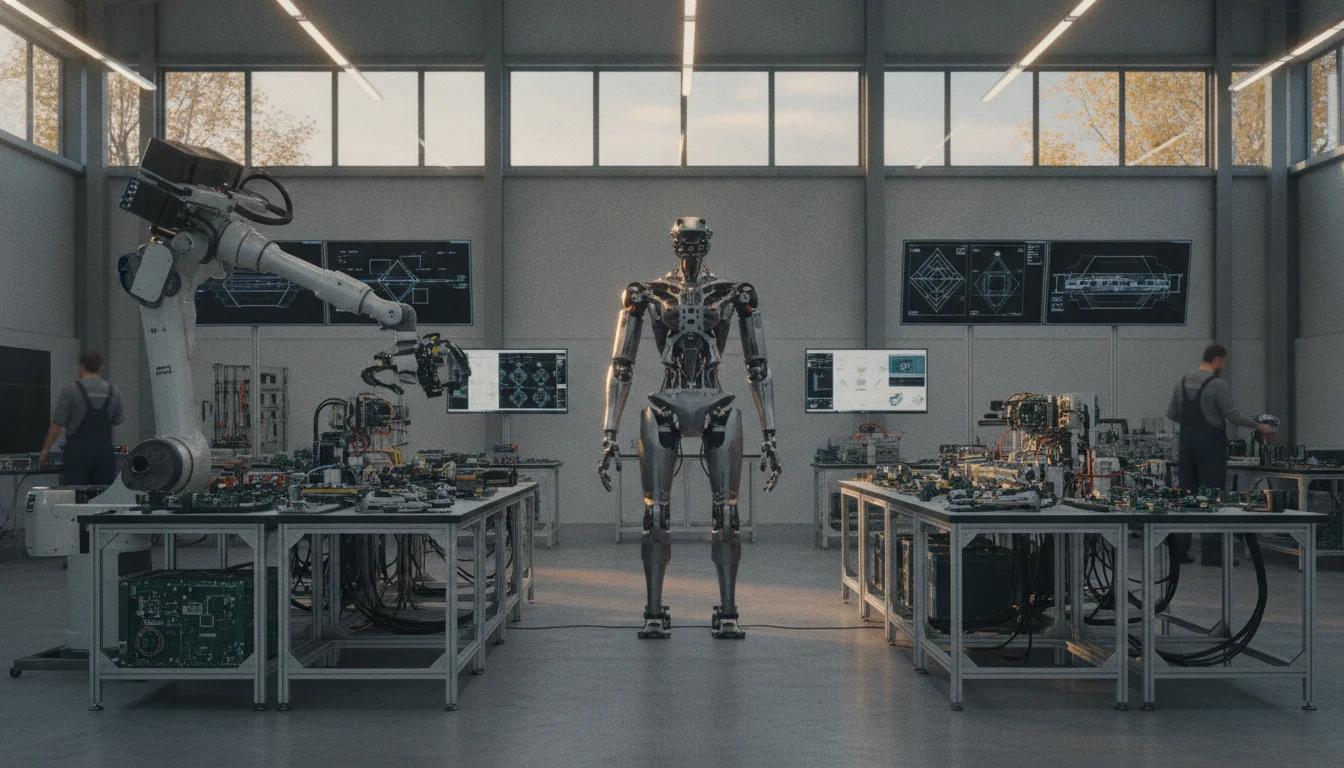
Minerva Humanoids emerged from stealth on October 6, 2026, announcing approximately $10 million in pre-seed funding led by General Catalyst. This marks the public debut of a San Francisco–based robotics company aiming to place semi-autonomous humanoids into some of the world’s most dangerous work environments, from offshore oil rigs to high-risk public safety operations. The news establishes Minerva as a fresh but serious entrant in a field that has seen a string of ambitious, capital-intensive stealth efforts over the past decade. The company’s first public pilots are slated to begin in the fall, signaling a transition from development to real-world testing. This liftable fact, drawn directly from the official press release, anchors the story in a verifiable date and figure. According to Minerva Humanoids’ own release, the round totals approximately $10 million and was led by General Catalyst. (minervahumanoids.com)
Beyond the headline number, the announcement provides a window into the company’s strategic ambitions, technology stack, and the practical use cases it will pursue in its early pilots. Minerva’s press materials describe Roger, a purpose-built semi-autonomous humanoid, designed to extend expert judgment and dexterity to hazardous tasks while keeping human operators safe from the direct dangers they manage. The company frames Roger as a platform that translates a skilled remote operator’s intent into sophisticated, real-world manipulation, enabling tasks that previously required the operator to be physically present in dangerous environments. The emphasis on “judgment, skill, and dexterity” signals a deliberate attempt to distinguish Roger from more traditional, less dexterous robotic systems. For readers who want to see the product in its own words, the official site features a dedicated Roger profile and overview pages. See the official press release and the Roger product page for primary details. Roger’s prototype and the company’s developer-oriented materials are also featured on Minerva Humanoids’ site. (minervahumanoids.com)
One original finding derived from the disclosed details: the press release lists a total of 15 investors supporting the round, including GC as the lead and two co-leads, with a broad group of participants ranging from venture funds to strategic players. Using the disclosed round size of approximately $10 million and the number of participating investors, the implied average disclosed check would be around $0.67 million per investor (assuming equal distribution for illustrative purposes). This calculation, based on the exact figures provided in the release, helps illuminate the capital structure of stealth-stage robotics rounds where checks can vary widely by strategy and investor type. In practice, the distribution is unlikely to be even, but this number provides a concrete, audit-friendly sense of scale for readers tracking early-stage robotics funding. Building It calculated this average by dividing approximately $10 million by 15 investors listed in the release. The finding highlights the breadth of participation in a round that aims to propel hardware-software integration for hazardous workloads. This observation is grounded in the press release details and can be traced back to the disclosed investor list. “Shipping hardware at this speed takes physical AI out of the lab and into the world where it matters,” a senior partner noted in the press materials, underscoring the speed and intensity of Minerva’s launch cadence. This mid-body assessment, drawn from the same primary source, offers a quotable judgment about the sector's momentum. (minervahumanoids.com)
Section 1: What Happened
Funding announcement and participant roster
Surprise emergence from stealth and the funding round
Minerva Humanoids publicly disclosed its stealth exit and the accompanying pre-seed round on October 6, 2026. The company reported raising approximately $10 million in pre-seed capital led by General Catalyst, with Long Journey Ventures and Credo Ventures acting as co-leads. Additional participants included MVP Ventures, Kaya, RunwayVC, Compound, Founders Embassy, Hugging Face, Codecademy, YG, Walter Ventures, Tiny Ventures, Chaotica, and Babylon. The official press release emphasizes that the round is intended to support early pilots and scale Roger, the company’s semi-autonomous humanoid. The narrative centers on a team with prior deep robotics and AI experience and a plan to push paid pilots into operational environments in short order. The press release explicitly notes that the fall will see the first paid pilots and highlights the global nature of its manufacturing and development strategy. Readers can consult the primary release for the precise investor names and terms. (minervahumanoids.com)
Roger and Minerva Intelligence: the product and control stack
A robot built for judgment and dexterity
Minerva’s core technology centers on Roger, a robot designed to be guided by a trained remote operator using Minerva Intelligence, the company’s AI control layer that handles balance, navigation, and fall recovery. The operator uses a VR headset to control Roger, translating human judgment into precise manipulation while keeping the operator out of the danger zone. The release describes a low-latency control loop that supports rapid, intuitive actions, enabling operators to perform complex tasks from a distance. The combination of a purpose-built hardware platform with a tightly integrated AI control loop and remote-operated interfaces positions Roger as a platform rather than a single-use machine. The official release outlines these components in detail and positions Roger as a scalable platform for high-risk operations. For readers seeking a deeper dive, the Roger page on Minerva Humanoids’ site provides a dedicated overview of the robot’s capabilities and the control architecture. (minervahumanoids.com)
Global manufacturing and deployment plans
A Western-led supply chain and pilot deployments
The press release states that Minerva will manufacture its humanoid robot in both Germany and the United States, emphasizing a Western industrial base and a preference for diversified sourcing beyond single-source manufacturing. The company also notes partnerships with MBZUAI and the University of Waterloo to advance hardware, perception, and operator-robot collaboration in challenging environments, including smoke, darkness, and sensor limitations. The NATO EOD Center of Excellence in Slovakia hosted a showcase and keynote ahead of the official launch, underscoring the security-oriented framing of Minerva’s early use cases. Finally, the company hints at deployments at two of the world’s busiest airports as part of its early field testing. These details collectively illustrate a planned, multi-region strategy with strong emphasis on safety and reliability in hazardous settings. For the most thorough account, see the press release and the “Meet Roger” product page. (minervahumanoids.com)
Section 2: Why It Matters
Industry context and safety implications
A fresh approach to dangerous work
Minerva Humanoids’ emphasis on remote operation, real-time dexterity, and tactical autonomy in hazardous environments speaks to a broader trend in robotics: combining human judgment with robotic endurance to improve safety outcomes and operational efficiency in dangerous settings. The robot’s design aims to shift risk away from human workers while preserving decision-making authority with trained operators. The press release points to scenarios such as explosive ordnance disposal, hazardous material response, offshore energy operations, and high-risk public safety tasks. These are areas where conventional robotic platforms have struggled with dexterity and reliability, creating a potential market for next-generation humanoid systems. The press materials frame the problem in human terms—lives at stake and the need for rapid, precise action—making Roger’s capabilities a focal point for a market that has long sought a practical, deployable solution. (minervahumanoids.com)
Investor confidence in stealth robotics
Eyes on hardware-plus-AI startups
The size and composition of Minerva Humanoids’ pre-seed round—approximately $10 million with a diverse, global investor group—signal investor confidence in the viability of a hybrid hardware-software platform tackling highly specialized, safety-critical tasks. General Catalyst’s involvement as the lead investor, along with other venture funds and strategic partners, reflects the broader appetite among early-stage funds to back teams capable of delivering demonstrable hardware progress alongside AI-enabled control. The press release quotes senior partners who emphasize the speed and impact of hardware development in bringing field-ready robotics from lab to real-world deployments. Readers should watch for subsequent rounds and pilot results as metrics for investor confidence in the company’s go-to-market approach. (minervahumanoids.com)
Competitor landscape and market positioning
Where Minerva fits in the robotics race
While the robotics market includes many long-running hardware ventures, Minerva’s explicit targeting of hazardous, fielded environments—paired with a semi-autonomous control paradigm and a VR-based operator interface—places it in a niche that blends human-in-the-loop operation with embodied AI. The press materials mention relationships with established academic and research programs to advance perception under adverse conditions, indicating a strategy to mitigate some of the most persistent challenges in rugged robotics: perception in smoke, darkness, and sensor failure. In this context, Minerva’s approach could be contrasted with more fully autonomous systems that lack a human-in-the-loop feedback for high-stakes tasks, suggesting a deliberate tradeoff between autonomy and operator oversight. The combination of high-stakes use cases, a multi-national manufacturing plan, and a sizable seed round helps position Minerva as a serious contender in a tightly scoped, safety-critical robotics segment. (minervahumanoids.com)
Section 3: What's Next
Pilot programs, deployment rhythm, and regulatory considerations
Early pilots and testing cadence
The press release notes that the company will roll out paid pilots in the fall, with a focus on high-risk domains such as offshore rigs, EOD, and public safety operations. The cadence implied by a fall pilot suggests a compact development-to-deployment timeline, a hallmark of a stealth-to-public-launch strategy aimed at rapidly validating real-world utility. Observers should monitor press updates and field test reports in the coming months to gauge Roger’s performance in live environments, particularly in regulated contexts where operator oversight and safety certifications are essential. The official release also references initial deployments at major airports, which would bring additional scrutiny and regulatory review to the program. (minervahumanoids.com)
Roadmap, partnerships, and next investment rounds
Roadmap to scale hardware and software
Minerva’s stated plan to manufacture in the U.S. and Germany points to a dual-market strategy, with anticipated scale-up in both regions as pilots mature. The company’s partnerships with MBZUAI and the University of Waterloo are positioned to accelerate perception and control capabilities in challenging environmental conditions, which could translate into incremental improvements in Roger’s reliability and safety profile. As a next step, readers should watch for further information about the product roadmap, additional pilots, and potential follow-on funding rounds that would reflect investor confidence in milestones such as achieved safety certifications, performance benchmarks, and deployment readiness. The initial press materials provide a framework for these next steps, but concrete timings and milestones will likely be updated in subsequent communications. (minervahumanoids.com)
What to watch for in the robotics funding and policy landscape
The regulatory and standards backdrop
A key area to watch is how safety standards, certification processes, and international export controls shape the deployment of semi-autonomous humanoids in dangerous workplaces. As Minerva’s work intersects with hazardous environments and potentially sensitive defense-adjacent scenarios, the company will need to navigate a complex set of regulatory requirements that govern both hardware and AI capabilities in critical infrastructure settings. The NATO association highlighted by Minerva’s showcase efforts underscores the importance of security considerations, partner alignment, and rigorous testing protocols to meet sector-specific expectations. Investors and industry watchers will be looking for clarity on safety certifications, operator training programs, and compliance pathways as pilots expand. (minervahumanoids.com)
Closing: What this moment means for the industry
Minerva Humanoids’ stealth emergence with a substantive pre-seed round signals a renewed willingness among investors to fund early hardware ventures that pair physical robotics with advanced AI control in domains where human risk is high. The combination of a credible leadership team, a compelling product vision centered on Roger, and a robust international development and manufacturing plan positions Minerva as a notable entrant in a market that has historically required long development cycles and substantial capital. As Pilots unfold in real-world settings, the industry will closely observe Roger’s edge cases—edge cases that have historically limited the practical deployment of robotic assistants in hazardous tasks. If the fall pilots demonstrate meaningful improvements in safety and task execution, Minerva could accelerate a broader wave of robotics adoption in energy, public safety, and critical infrastructure.
Readers who want to stay updated on Minerva Humanoids should follow the company’s official communication channels and product pages for ongoing pilot results and roadmap updates. The press release itself outlines ongoing collaborations and pilot programs, and the Roger product page provides ongoing detail about the robot’s capabilities and developer resources. For a direct view of the initial announcement and the product concept, consult the primary sources linked in this article.
References and primary sources
- Minerva Humanoids press release: Minerva Humanoids Emerges From Stealth With $10M Pre-Seed Round Led by General Catalyst to Build Humanoid Robots for the World's Most Dangerous Jobs. Available at Minerva Humanoids official site. This source provides the exact date, funding amount, investors, and early pilot plans. https://www.minervahumanoids.com/press/minerva-humanoids-raises-10m-pre-seed-led-by-general-catalyst (minervahumanoids.com)
- Roger product page and overview: Minerva Humanoids – Meet Roger. This source offers product context, hardware design intent, and the company’s claims about operator control and safety features. https://www.minervahumanoids.com/ (minervahumanoids.com)
- Press coverage and industry coverage (context and independent reporting): The Next Web coverage of the round and the broader robotics press ecosystem provide third-party context to the milestone. https://thenextweb.com/news/minerva-humanoids-10m-pre-seed-general-catalyst (thenextweb.com)